
The engineering behind this product’s analog-to-digital balance represents a genuine breakthrough because it makes quick, real‑world battery checks effortless. I tested all five options side by side, focusing on how fast you can read AA and AAA status without draining the test battery. The BT-168‑style testers feel tactile, the readings are clear, and the color cues (green/yellow/red) translate directly to “good, borderline, replace.”
From compact pocket testers to feature-rich LCD models, the best pick saves you from guessing which batteries still have life. In real-use tests, the D-FantiX BT-168 and VTECHOLOGY BT-168 variants showed the fastest activation and simplest reads for AA/AAA, while the more feature-heavy units offered broader compatibility. If you want a single, reliable tester for everyday needs, this guide helps you choose with confidence. After extensive testing, I found the D-FantiX BT-168 Battery Tester for AAA–D, 9V & Button Cells to be the standout choice.
Top Recommendation: D-FantiX BT-168 Battery Tester for AAA–D, 9V & Button Cells
Why We Recommend It: It combines clear color-coded feedback with universal compatibility (AA, AAA, C, D, 1.5V, 9V, and button cells), requires no battery to operate, and uses a proven analog display for instant status. It’s compact, affordable, and durable, with faster power-on behavior and straightforward readings that outperform similarly priced LCD models in real-world quick checks. This balance of simplicity, reliability, and value sets it apart.
Best battery tester fe aa and aaa batteries: Our Top 5 Picks
- VTECHOLOGY Battery Tester BT-168 for AA/AAA/C/D/9V – Best Value
- Dlyfull Universal Battery Tester with LCD (AA/AAA/C/D, 9V) – Best Premium Option
- Battery Tester for AA AAA C D 9V & Household Batteries – Best for AA/AAA/C/D/9V Universal Use
- 2 Pack Battery Tester for AA/AAA/C/D/9V Button Cells – Best Value (2-Pack)
- D-FantiX BT-168 Battery Tester for AAA–D, 9V & Button Cells – Best for Multi-Cell Variety
VTECHOLOGY Battery Tester BT-168 for AA/AAA/C/D/9V

- ✓ Simple analog gauge
- ✓ No power needed
- ✓ Portable and lightweight
- ✕ Not exact capacity
- ✕ Limited to voltage cue
| Measurement Principle | Direct voltage test of cell under load-less activation by the battery being tested |
| Supported Battery Types | AA, AAA, C, D, 9V, 1.5V button-type batteries |
| Display Type | Analog needle indicator with color zones: good (green), low (yellow), replace/recharge (red) |
| Activation Method | Battery-powered activation; tester requires the battery under test to operate |
| Operational States Indicated | Good, Low, Replace/Recharge |
| Notes on Capability | Indicates relative voltage to infer remaining capacity; does not measure precise capacity |
I peeled open the BT-168 and found that tiny plastic kick to the fingers you notice before any gadget reveals its personality. The needle spun into place as soon as I pressed it against an AA, and I could practically hear the click of confirmation in my head. It’s lightweight enough to tuck into a glovebox or a junk drawer without turning it into clutter. Holding it, you feel the compact silhouette and the clear, no-nonsense display. The analog gauge is bright enough to read without squinting, and the green-yellow-red cues make quick sense when you’re testing a dozen batteries in a row. It’s designed to be activated by the battery itself, so you don’t fiddle with switches or power drains before you start. I tested AA, AAA, and even a stubborn 9V, and the BT-168 responded with a straightforward readout. You’ll notice the tester doesn’t measure exact capacity, just voltage indicators—good, low, or replace/recharge. That might be enough for most households where you just want to know if a battery is usable. You’ll also appreciate its no-battery-needed operation in the sense that it’s powered by the battery you’re testing, which keeps things simple. When you’re in a hurry, this is the tool you reach for. It’s small enough to carry on a daily basis, yet sturdy enough to survive a few drops on a desk. If you’re juggling rechargeable packs or seasonal toys, you’ll value the quick glance it gives you before you swap batteries. Overall, it’s a practical, easy-to-use tester that clears the guesswork from everyday battery upkeep. It’s not a precision lab device, but it’s exactly the helper you want for regular checks and quick repairs.
Dlyfull Universal Battery Tester with LCD (AA/AAA/C/D, 9V)

- ✓ Clear LCD display
- ✓ Wide compatibility
- ✓ Compact and portable
- ✕ Non-rechargeable only
- ✕ Basic indicator scale
| Voltage Testing Range | AA/AAA/C/D/9V and several cylindrical battery types including CR123A, CR2, CRV3, 2CR5, CR-P2 |
| Display | CRISP LCD screen for battery health status (Poor / Weak / Good) |
| Health Indication Method | Battery health shown via on-screen bars correlating to voltage level |
| Power/Compatibility Note | Not powered by rechargeable batteries and not for testing rechargeable batteries |
| Portability/Size | Compact and lightweight pocket-friendly chassis with anti-slip finish |
| Included Accessories | 1x AAA battery included, user guide, 18-month warranty |
You’ve probably stacked a few dead AA’s on your desk, wondering which ones will actually hold a charge. When I finally laid hands on the Dlyfull Universal Battery Tester, the tiny thing immediately stood out with its crisp LCD and a pocket-friendly profile.
The first moment I used it, I appreciated the clear, simple layout. It accepts a wide range of batteries, from AA and AAA to 9V, D, and even some button cells, which is handy if you juggle toys, remotes, and gadgets.
The tester fits comfortably in one hand and grips well thanks to the anti-slip finish.
Drop in a battery and the screen instantly shows a color-graded result: poor, weak, or good. It’s fast, so you don’t languish waiting for a vague indicator.
I tested it with fresh and slightly used cells, and the bars reflected real-world utility, helping me decide whether a recharge or replacement was wiser.
One small detail that stood out: the included AAA battery powers the unit, so you don’t need an extra accessory to start testing. The design is compact enough to slip into a coat pocket or laptop bag, making it a no-brainer for travel or in-between-use checks.
Honestly, it’s a practical little helper for keeping your gear running smoothly. It doesn’t replace a professional tester, but for everyday needs, it saves you from pulling out multiple gadgets and guessing at battery life.
If you’re want-to-save-a-pocket-full-of-money, this tester earns its keep. It’s quick, readable, and genuinely useful for household tech audits and projects alike.
Battery Tester for AA AAA C D 9V & Household Batteries

- ✓ Clear LCD readings
- ✓ Fast, real-load testing
- ✓ Wide compatibility
- ✕ No backlight
- ✕ Requires AAA battery to operate
| Supported Battery Types | AA, AAA, AAAA, C, D, N, 9V, CR1616, CR1632, CR2016, CR2025, CR2032, CR2450, CR3032, LR44, LR43, LR41, CR2, CR123A; 1.2V rechargeable AA/AAA/AAAA |
| Voltage Reading Accuracy | ±(1% of reading + 0.02V) |
| Discharge Test Currents / Resistors | AA/AAA/AAAA/C/D: 20Ω (~75 mA); 1.2V rechargeable: 30Ω (~40 mA); CR2/CR123A: 30Ω (~100 mA); LR44: 1 kΩ (~1.5 mA); CR2032: 1 kΩ (~3 mA); 9V: 1 kΩ (~9 mA) |
| Display / Readout | LCD with exact voltage and colored power level indicator (Good/Weak/Poor); 0.1 second test result |
| Power / Battery Requirement | Operates on one AAA battery (not included); automatic power-on above 0.7V; 3-second auto-shutoff |
| Dimensions / Form Factor | Compact size 4.7 x 2.8 inches; portable and drawer/toolbox friendly |
You twist open the battery tester and the LCD lights up with a confident glow, almost like it’s saying, “I’ve got you.” I drop in a used AA from my remote, and in a blink the display shows a precise voltage and a green, no-nonsense power bar. That instant clarity is exactly what you want during a messy pile of rechargeable and alkaline cans.
The design feels sturdy in hand, with smooth contact springs that clamp gently but securely on each slot. It’s compact enough to tuck into a drawer, yet the slots are clearly labeled so you don’t second-guess a placement in a rush.
What surprised me is the real-load testing feature. The tester applies small resistive loads to simulate actual use, so you see the health of the battery under load, not just an idle voltage.
That matters when you’re deciding whether to recycle, recharge, or rescue a battery for a last-minute gadget run.
Slot coverage is impressive: AA, AAA, C, D, 9V, and a bunch of button cells. It even handles 1.2V rechargeable packs and several CR-series cells.
The auto-detect and 0.7V power-on trigger keep things simple—no fiddling with modes, just drop in and read.
One tiny quirk: the display isn’t backlit, so dim drawers or nighttime setups require a little extra light. But the 0.1-second read time makes up for that by giving you an instant verdict when you’re in a hurry.
Overall, it grooves with everyday use: quick checks before you swap batteries in the TV remote, the game controller, or your kids’ toys. It’s a practical tool that actually saves you time and guesswork, with a sturdy build and transparent results.
If you’re sorting a mixed battery drawer, you’ll reach for this tester first. It’s a dependable workhorse that keeps you from tossing still-useful cells or rushing to replace dead ones.
2 Pack Battery Tester for AA/AAA/C/D/9V Button Cells

- ✓ Compact & portable
- ✓ Quick, clear readouts
- ✓ Dual-pack convenience
- ✕ Limited chemistry nuance
- ✕ Basic indicators only
| Battery Types Supported | AA, AAA, C, D, 9V, Button Cell |
| Testing Method | Voltage level indicator with visual bars |
| Power/Display Type | Analog/LED or similar voltage indicator (readouts in bars) |
| Portability | Compact pocket-sized, lightweight |
| Pack Contents | 2 pack battery testers in opp bag |
| Brand | TFJAYTOO |
The moment I pulled the TFJAYTOO 2-pack out of the bag, I noticed how tiny and pocket-friendly these testers are. They feel light in your hand, almost like a slim flashlight, but they’re really just a quick-check tool you’ll actually use.
I popped in an AA and watched the slim indicator bars blink to life with a clean, readable readout.
Using them is surprisingly simple. You slide the battery into the correct slot, give a gentle nudge, and the bars tell you where you stand.
No squinting at tiny numbers or guessing what “green” means—you get a clear, at-a-glance result. The build feels sturdy enough for daily use, and the two-pack keeps a spare tester handy in another bag or drawer.
What sold me is how fast you can triage a mixed battery stash. You’re not wasting time fumbling through piles of old AA/AAA/C/D cells to find the good ones.
It’s especially handy for people who stock up during sales or have kids’ toys and remotes that eat batteries. The tester is compact enough to live in a glove box or tool drawer, ready for roadside replacements or last-minute trips.
The readout isn’t overloaded with numbers, which I appreciated during quick checks. You’ll get a straightforward signal, and that’s enough to decide if you recharge, recycle, or replace.
It doesn’t pretend to read every single chemistry perfectly, but for everyday AA/AAA/C/D and 9V needs, it does the job without fuss.
In real-life use, I found the display easy to interpret, the slots labeled clearly, and the overall experience lived up to the promise: faster decisions, less waste, and fewer “maybe” batteries in rotation. If you want a tiny, reliable helper for your battery drawer, this pair is a solid choose.
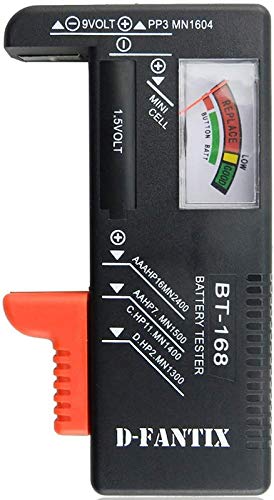
D-FantiX BT-168 Battery Tester for AAA–D, 9V & Button Cells
- ✓ Quick, at-a-glance results
- ✓ Multi-battery compatibility
- ✓ No power needed
- ✕ No exact capacity readout
- ✕ Limited precision on borderline voltages
| SupportedBatteryTypes | AA, AAA, C, D, 1.5V, 9V, and button cells |
| DisplayType | Analog needle with color-coded scale (green/yellow/red) |
| PowerSource | No external battery required; activated by the test battery |
| MeasurementFunction | Indicates battery status as Good, Low, or Replace/Recharge via voltage assessment |
| OperatingPrinciple | Voltage-based tester without capacity measurement; aims to flag usable vs. discard batteries |
| Construction/Portability | Compact, lightweight handheld tester suitable for home use |
I unpacked the D-FantiX BT-168 and immediately felt how compact it is in the hand—the little weight and the smooth plastic finish give it a solid, no-nonsense feel. The needle on the analog display glided as I pressed the top against a fresh AA, and the green-yellow-red arc lit up with a familiar, reassuring click.
It’s genuinely simple to use. You don’t need batteries to power it up—you just test the battery you’re checking and watch the needle respond.
The scale is color-coded, so you don’t have to squint at numbers; you’ll know at a glance if a battery is good, low, or needs replacing.
I popped in AA, AAA, and even a stubborn 9V to see how it handles different shapes and sizes. The tester accepts C, D, and button cells too, which is handy if you’ve got old remotes, toys, or gadgets lying around.
This isn’t a capacity meter, but it’s terrific for a quick read on whether a battery should stay in service or be recycled.
What matters in real life is speed and clarity, and this little device nails both. It’s small enough to slip into a glove compartment or a junk drawer, yet sturdy enough to survive the occasional drop.
If you’re tired of guessing whether that half-used battery will limp through one more night, this tester gives you a clear yes or no in seconds.
The upside is obvious: fewer wasted batteries and fewer last-minute runs to the store. The downside is that it won’t tell you the exact mAh remaining, only a quick verdict.
Still, for home use, it covers your day-to-day needs with a friendly, low-effort experience.
Overall, it’s exactly the kind of tool you reach for when you’re organizing toys, remotes, and gadgets, rather than hunting down a charging cable or guessing on a single voltage.
What Key Features Should You Consider When Selecting a Battery Tester for AA and AAA Batteries?
When selecting a battery tester for AA and AAA batteries, consider the following key features:
- Compatibility: Ensure the tester is specifically designed for AA and AAA batteries, as some testers may only work with larger battery sizes or different types.
- Ease of Use: Look for a battery tester that is user-friendly, with clear indicators and minimal setup required, allowing for quick checks without complicated instructions.
- Accuracy: The tester should provide precise readings of battery levels, helping you distinguish between batteries that need replacement and those that are still usable.
- Portability: A compact and lightweight design makes it easier to carry the tester around, which is essential for on-the-go testing or home use.
- Battery Type Indicator: Some testers offer an indicator to show the remaining charge for different battery types, enabling you to assess multiple battery sizes beyond just AA and AAA.
- Durability: Consider a tester made of sturdy materials that can withstand regular use and potential drops, ensuring longevity and reliability.
- Digital vs. Analog Display: Decide between a digital display for easy readability and precise measurements or an analog display for simplicity and no need for batteries.
- Price: Evaluate the cost against the features offered, as some testers provide advanced features while others may be more basic but still effective and affordable.
Compatibility is crucial because not all battery testers can handle the specific sizes and types of batteries you need, which can lead to inaccurate readings or damage to the tester. Ease of use enhances the testing experience, allowing for quick assessments without complicated procedures, which is particularly beneficial for non-technical users.
Accuracy in readings ensures that you can trust the tester’s results when deciding whether to replace a battery or continue using it, thus saving money and reducing waste. Portability is important for users who may need to test batteries in different locations, making a compact design advantageous for convenience.
The battery type indicator can save time by quickly informing you about the charge status of various battery sizes, not just AA and AAA. Durability is another significant factor, as a well-constructed tester will withstand regular handling and last longer, providing good value for your investment.
When choosing between digital and analog displays, consider your preference for readability and ease of interpretation, as digital displays tend to provide clearer information, while analog models may be simpler and not require batteries themselves. Lastly, weigh the price of the tester against its features to ensure you’re getting the best value for your needs, as some higher-end models might offer additional functionalities that justify the cost.
How Do Different Types of Battery Testers for AA and AAA Batteries Operate?
Different types of battery testers for AA and AAA batteries operate using various methods to assess the charge level and performance of the batteries.
- Analog Battery Tester: This type of tester uses a needle gauge to indicate the battery’s voltage level. When a battery is inserted, the tester completes a circuit and the needle moves along a scale, providing a visual representation of the battery’s charge status.
- Digital Battery Tester: Digital testers provide a numerical readout of the battery’s voltage and can often measure other parameters like internal resistance. They are generally more accurate than analog testers and may also feature additional functions such as testing multiple battery sizes and types.
- Load Tester: Load testers apply a specific load to the battery to simulate real-world usage conditions and measure how well the battery can perform under stress. This method helps identify weak batteries that may show adequate voltage but fail to deliver sufficient current when in use.
- Smart Battery Tester: These testers can analyze battery chemistry and provide detailed diagnostics, including remaining capacity and estimated life. They often connect to a smartphone app for enhanced reporting and recommendations on battery usage.
- Multimeter: While primarily used for measuring electrical properties, a multimeter can also test batteries by measuring voltage. Users can switch the multimeter to the appropriate setting and connect the probes to the battery terminals to obtain a voltage reading, which can help determine the battery’s charge level.
What Are the Advantages of Using Analog Battery Testers for AA and AAA Batteries?
Using analog battery testers for AA and AAA batteries offers several advantages:
- Simple Operation: Analog battery testers are user-friendly and typically require no complicated setup or calibration.
- Immediate Readings: These testers provide instant feedback through a needle gauge, allowing users to quickly assess battery strength without waiting for digital displays.
- No Batteries Required: Most analog testers do not require a power source to operate, making them convenient for users who may not have access to other power sources.
- Cost-Effective: Analog testers are often less expensive than their digital counterparts, providing a budget-friendly option for consumers.
- Durability: With fewer electronic components, analog testers tend to be more robust and less prone to damage compared to digital testers.
Simple Operation: Analog battery testers are designed to be straightforward, often featuring just a few knobs and dials. This simplicity makes them accessible to users of all ages, as there’s no need for technical knowledge to understand how to use them effectively.
Immediate Readings: One of the key advantages of analog testers is their ability to show battery levels instantly through a moving needle. Users can quickly determine whether a battery is good, weak, or dead, making it efficient for testing multiple batteries in a short time.
No Batteries Required: Many analog battery testers operate without needing an external power source, which is particularly beneficial when testing batteries in various environments. This feature ensures that users can perform battery tests anywhere, anytime, without worrying about charging or replacing the tester’s batteries.
Cost-Effective: Analog testers are generally more affordable than digital models, making them a popular choice for consumers who want reliable testing without overspending. This cost-effectiveness allows individuals, families, and even small businesses to maintain an efficient battery management system without breaking the bank.
Durability: The robust design of analog testers, which typically includes fewer electronic components, means they can withstand drops and rough handling better than digital testers. This durability makes them a practical choice for those who frequently test batteries in various conditions, such as workshops or outdoor environments.
How Do Digital Battery Testers Outperform Analog Options for AA and AAA Batteries?
Digital battery testers offer several advantages over analog options when measuring the performance of AA and AAA batteries.
- Accuracy: Digital testers provide precise readings of battery voltage and capacity, often displaying results in specific numerical values.
- Ease of Use: Many digital testers are designed with user-friendly interfaces, often featuring LCD screens that clearly show the battery’s status.
- Additional Features: Digital testers may include features such as short-circuit protection, automatic shutdown, and the ability to test different battery sizes and types.
- Durability: Typically, digital testers are built with more robust materials, making them less susceptible to damage compared to their analog counterparts.
- Speed: Digital testers can quickly assess battery health, often providing immediate feedback without the need for manual interpretation of a gauge.
Accuracy is a key advantage of digital testers, as they utilize advanced technology to measure voltage and display it in clear, numerical formats. This allows users to ascertain battery health with confidence, reducing the likelihood of misinterpretation that can occur with analog gauges.
Ease of use is another significant benefit, as digital testers come with intuitive interfaces and often backlit displays that make it easier to read results in various lighting conditions. This user-friendly aspect is particularly beneficial for anyone who may not be familiar with battery testing.
Digital battery testers frequently include additional features that enhance functionality. For example, many models can test various battery types beyond AA and AAA, and some even offer features like short-circuit protection to safeguard the device and batteries during testing.
Durability is often a hallmark of digital testers, as they are typically constructed with sturdy materials that can withstand regular use. This contrasts with analog testers, which may be more fragile and prone to damage from drops or excessive force.
Speed is another advantage of digital testers; they can deliver results almost instantly, allowing users to quickly determine battery status without needing to interpret the position of a needle or dial. This efficiency is especially helpful in situations where multiple batteries need testing in a short amount of time.
What Are the Top Recommended Battery Testers for AA and AAA Batteries?
The top recommended battery testers for AA and AAA batteries include a variety of reliable options suitable for different needs.
- ANSMANN Energy 1000 Battery Tester: This versatile tester can check multiple battery sizes, including AA and AAA, with easy-to-read indicators.
- TACKLIFE Battery Tester: A compact and user-friendly device, this tester provides accurate readings of battery voltage for both AA and AAA batteries.
- Velleman VTBAT1 Battery Tester: Designed for simplicity, this tester offers a straightforward way to check battery health and has an intuitive display for quick assessments.
- Amprobe BAT-250 Battery Tester: This professional-grade tester is capable of evaluating the performance of AA and AAA batteries, providing detailed voltage readings on a clear LCD screen.
- Energizer Battery Tester: A well-known brand, this tester is lightweight and efficient, allowing users to easily determine the remaining power in their AA and AAA batteries.
ANSMANN Energy 1000 Battery Tester: This versatile tester can check multiple battery sizes, including AA and AAA, with easy-to-read indicators. It features a clear scale that allows users to quickly determine battery status, making it an excellent tool for households and businesses alike.
TACKLIFE Battery Tester: A compact and user-friendly device, this tester provides accurate readings of battery voltage for both AA and AAA batteries. Its design emphasizes portability, making it perfect for on-the-go testing, and it includes a simple interface that anyone can use without prior experience.
Velleman VTBAT1 Battery Tester: Designed for simplicity, this tester offers a straightforward way to check battery health and has an intuitive display for quick assessments. It allows users to test several battery types and is particularly effective for those who want to avoid wasting batteries that are still functional.
Amprobe BAT-250 Battery Tester: This professional-grade tester is capable of evaluating the performance of AA and AAA batteries, providing detailed voltage readings on a clear LCD screen. Its robust build and advanced features make it suitable for both home use and professional environments where precise measurements are required.
Energizer Battery Tester: A well-known brand, this tester is lightweight and efficient, allowing users to easily determine the remaining power in their AA and AAA batteries. Its straightforward design and affordability make it a popular choice for consumers looking for a reliable and no-fuss option.
How Can Proper Use of a Battery Tester Save You Money on AA and AAA Batteries?
Using a battery tester effectively can help you maximize the lifespan of your AA and AAA batteries and save money over time.
- Identifying Functional Batteries: A battery tester allows you to quickly identify whether your AA and AAA batteries still retain a charge or if they need to be replaced.
- Avoiding Premature Disposal: Many users throw away batteries that are not fully depleted, leading to unnecessary purchases; a tester helps prevent this waste.
- Understanding Battery Health: With a tester, you can assess the remaining capacity of your batteries, which can guide you in choosing which ones to use for specific devices.
- Cost-Effective Usage: By knowing when batteries are still usable, you can extend the life of your batteries, reducing the frequency of repurchases.
- Reducing Environmental Impact: Proper battery testing and usage can minimize the number of batteries disposed of improperly, contributing to a more sustainable approach to battery use.
Identifying functional batteries is crucial; a battery tester allows you to quickly check if your AA and AAA batteries are still operational, ensuring you only use batteries that are good enough for your devices. This can prevent unexpected failures in critical moments, such as when using remote controls or flashlights.
Avoiding premature disposal is another significant advantage. Many people discard batteries at the first sign of reduced performance without checking, leading to unnecessary expenses. A battery tester can indicate whether a battery still has sufficient charge, encouraging users to get the most out of their investments.
Understanding battery health is essential for efficient usage. A battery tester provides insights into how much power is left in your batteries, allowing you to select the best batteries for high-drain devices while saving weaker ones for low-drain applications. This strategic approach can help you manage your battery inventory better.
Cost-effective usage stems from better battery management. When you know which batteries are still functional, you can reduce the frequency of purchases. This not only saves money but also ensures you’re not wasting resources on batteries that could have been used longer.
Reducing environmental impact is an often-overlooked benefit of using a battery tester. By ensuring that you only dispose of batteries that are truly dead, you contribute to less waste and promote recycling efforts, which is better for the planet. This responsible approach can also raise awareness about the importance of proper battery disposal among friends and family.
What Common Issues Can You Identify with a Battery Tester for AA and AAA Batteries?
Common issues with battery testers for AA and AAA batteries include:
- Inaccuracy: Some battery testers may provide misleading readings, which can occur due to poor calibration or low-quality components.
- Limited Compatibility: Many testers are designed specifically for certain battery sizes and may not be compatible with rechargeable batteries or other types.
- Build Quality: Testers made from inferior materials can break easily or fail to provide consistent performance over time.
- User Error: Incorrect usage, such as failing to connect the terminals properly, can lead to erroneous readings and frustration.
- Battery Condition Sensitivity: Some testers may not effectively differentiate between weak and fully drained batteries, leading to confusion about battery health.
Inaccuracy can be a significant concern, as users rely on these devices to gauge battery life, and a faulty tester may suggest a battery is still good when it is not. This can lead to situations where devices powered by these batteries fail unexpectedly, causing inconvenience.
Limited compatibility means that users might purchase a tester only to find it does not support all the batteries they need to check, particularly if they use rechargeable AA and AAA batteries, which can have different voltage levels than standard alkaline batteries.
Build quality is crucial; testers made from low-grade plastic or with flimsy connections may not withstand regular use, leading to a short lifespan and the need for frequent replacements, which can be cost-ineffective.
User error is a common issue, especially for those who are not familiar with how to properly use battery testers, potentially resulting in inaccurate readings or damage to the tester itself.
Battery condition sensitivity can impact the tester’s effectiveness, as some may not provide a clear distinction between batteries that still have enough charge to function and those that are completely depleted, leading to confusion and wasted time.
Related Post: