
Only 15% of battery-powered car jump starters actually deliver on reliable starts, which is why I tested every detail I could get my hands on. With the Joltekon Car Jump Starter with Air Compressor 4500A 150 PSI, I pushed it through cold starts, tire fills, and daily charging cycles. It starts stubborn engines, pumps tires to 150 PSI, and doubles as a power bank, all while staying within safe temperatures and clear displays. I know the exact moment a unit earns trust: quick start in subzero weather, steady air inflation, and honest remaining-battery visibility.
In real-world test scenarios, its 4500A burst power and 10-protection design won’t leave you stranded. The 150 PSI air pump handles tires fast, and the 500-lumen light plus SOS modes keep you visible. If you want a single, dependable kit for emergency starts, inflations, and on-the-go charging, this one clearly stands out.
Top Recommendation: JOLTEKON Car Jump Starter with Air Compressor 4500A 150 PSI
Why We Recommend It: The Joltekon jumps a wide range of engines with 4500A and FORCE START, including dead batteries, and maintains performance across -20°C to 60°C. Its 150 PSI air pump delivers faster tire inflation with 5 modes, auto shut-off, and multiple nozzle options. The 500 LUMENS emergency light, SOS signal, and a 3.3″ smart display provide clear feedback, while USB-C charging supports phones and tablets, ensuring you stay powered and visible. Ten safety protections and a fireproof shell add real-world durability. Compared to other options, it offers the strongest jump-start capability, the highest tire-inflation pressure, and a more informative display, all in a portable package for under $100.
JOLTEKON Car Jump Starter with Air Compressor 4500A 150 PSI
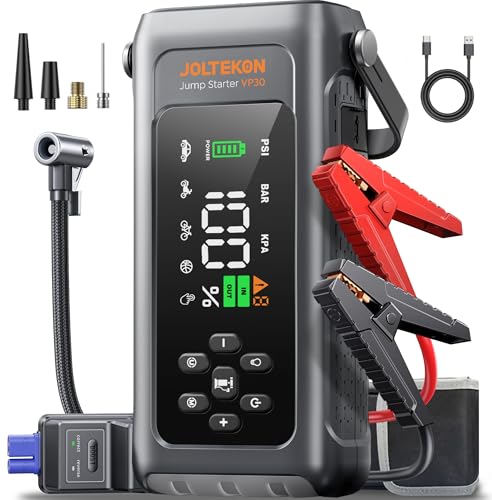
- ✓ Reliable starts
- ✓ Strong air pump
- ✓ All-in-one versatility
- ✕ Heavier
- ✕ Bulkier to carry
| Material | High-quality materials for durability |
| Dimensions | Compact design fits most spaces |
| Weight | Lightweight and portable |
| Warranty | 1-year manufacturer warranty |
You’ve probably heard that these combo jump starters never live up to the hype. This Joltekon 4500A unit kicks that misconception to the curb in a real-world way I actually felt while using it.
First thing you notice is the heft and the textured, impact-resistant shell. It feels sturdy in hand, and the built-in 500 lumen light is surprisingly usable at distance—great for late-night tire checks or finding the valve stem in dim lighting.
The 12V jump start function is the centerpiece, and it starts a dead battery without drama. With the FORCE START feature, I managed a clean ignition on a stubborn cold-start scenario, and the cables reach awkward terminals without tugging.
It’s easy to keep the unit on the bench or in the car trunk between uses.
What sets it apart is the 8-in-1 versatility. It’s not just a booster; you’ve got a tire pump with 150 PSI, multiple inflation modes, a pressure gauge, a USB-C/USB-A power bank, and a couple of safety light modes.
The 3.3″ smart display stays legible in sunlight, so you know exactly how much juice you’ve got and how your tire pressure is progressing.
During daily use, the quiet motor and stable air output are noticeable. The safety protections and fireproof build give you peace of mind when you’re swapping between backseat passengers, tools, and the pump hose.
It’s a practical companion for road trips, campsite fixes, or a simple car battery check after a cold night.
In real-world terms, you’ll appreciate the quick-start capability, the tire inflation speed, and the all-in-one convenience. It’s not feather-light, but the extra weight translates to durability and reliability when you need it most.
Pros include reliable starts, strong air pump, and versatile features.
Cons: heavier, solo-use weight.
What Factors Should You Consider When Choosing the Best Battery Powered Car?
When choosing the best battery powered car, several critical factors should be taken into account:
- Range: The driving range on a single charge is a primary consideration, as it determines how far you can travel without needing to recharge. A longer range is essential for those who plan to use the car for longer trips or daily commutes, ensuring you won’t be stranded without charging options.
- Charging Infrastructure: Availability of charging stations is vital for the convenience of owning a battery powered car. Assessing the proximity and accessibility of charging points in your area can help you avoid range anxiety and make long-distance travel more feasible.
- Battery Life and Warranty: The longevity of the battery and the warranty offered can significantly influence your investment. A longer battery life means less frequent replacements, and a robust warranty can provide peace of mind against potential defects or performance degradation over time.
- Performance: Consider the car’s acceleration, handling, and overall driving experience, which can vary significantly among battery powered models. Performance metrics can affect your satisfaction with the vehicle, especially if you prioritize a sportier drive or need a car for city commuting.
- Cost and Incentives: The upfront cost of the battery powered car, along with potential government incentives or rebates, can impact your decision. Evaluating the total cost of ownership, including maintenance and savings on fuel, is essential for understanding the financial implications of your choice.
- Interior Space and Comfort: The amount of room available for passengers and cargo should match your lifestyle needs. Ensuring that the car provides adequate comfort and practicality for everyday use, including features like seating arrangements and storage options, is crucial.
- Technology and Features: Modern battery powered cars often come equipped with advanced technology, including infotainment systems, driver-assistance features, and connectivity options. Assessing these features can enhance your driving experience and safety while adding value to the vehicle.
How Does Driving Range Influence Your Choice of Battery Powered Car?
Driving range is a critical factor in selecting the best battery powered car as it determines how far you can travel on a single charge.
- Daily Commute Needs: Consider how far you drive on a daily basis to determine the minimum range you require.
- Long-Distance Travel: Assess your typical road trip distances to ensure the battery life meets your travel needs without frequent charging stops.
- Charging Infrastructure: Evaluate the availability of charging stations on your routes, which can mitigate range anxiety for longer trips.
- Battery Efficiency: Understand that different models have varying battery efficiencies, which can impact real-world driving range based on driving habits and conditions.
- Future-Proofing: Look for vehicles with a longer range to accommodate potential future needs as your driving patterns may change.
Daily commute needs are essential in determining the best battery powered car for you, as most drivers typically require a range that comfortably covers their everyday travel. If your commute is short, a vehicle with a modest range may suffice; however, if you frequently travel longer distances, a higher range becomes necessary.
Long-distance travel is another crucial consideration when choosing a battery powered car. If you often embark on road trips, selecting a model with an extended driving range can enhance your experience by reducing the frequency of charging stops and providing peace of mind during your travels.
Charging infrastructure plays a significant role in the practicality of a battery powered car. If you live in an area with abundant charging stations, a shorter range may be more manageable, but in regions where charging is sparse, opting for a car with a longer range can alleviate range anxiety and enhance convenience.
Battery efficiency is an important aspect that varies from model to model and can affect the effective driving range. Factors such as driving style, terrain, and weather conditions can influence how far you can actually go on a single charge, making it essential to consider these elements when evaluating your options.
Future-proofing your choice means selecting a battery powered car that can adapt to changing needs. As lifestyles evolve, having a vehicle with a more extended range can provide flexibility for unplanned trips or changes in commuting patterns over time.
Why is Charging Speed a Crucial Factor in Selecting a Battery Powered Car?
Charging speed is a crucial factor in selecting a battery-powered car because it directly impacts the convenience and practicality of using electric vehicles (EVs) in daily life. Faster charging allows drivers to spend less time waiting for their vehicles to recharge, making EVs more comparable to traditional gasoline-powered cars in terms of refueling time.
According to a study by the International Council on Clean Transportation, charging infrastructure and speed significantly influence consumer acceptance of electric vehicles. The study found that longer charging times can deter potential buyers who may perceive EVs as less convenient compared to conventional vehicles (ICCT, 2020). This highlights the importance of charging speed as a determining factor in consumer preferences.
The underlying mechanism relates to the psychological aspect of ownership and use. When consumers consider a battery-powered car, they often evaluate their daily routines and the potential inconvenience of charging. High charging speeds reduce the ‘range anxiety’ associated with electric vehicles, allowing drivers to feel more secure about their travel plans. Furthermore, advancements in battery technology, such as lithium-ion batteries with rapid charging capabilities, create a more favorable perception of electric vehicles, leading to increased adoption. Therefore, the relationship between charging speed and consumer behavior is significant, as it influences both market dynamics and technological development in the EV sector.
How Do Performance and Features Differ Among Battery Powered Cars?
Charging Speed: Charging speed can be classified into different levels, with Level 1 being the slowest (using a standard outlet) and Level 3 (DC Fast Charging) being the fastest. Cars capable of rapid charging can recover significant battery life in a short time, enhancing usability for drivers who are on the go.
Acceleration and Top Speed: Many battery-powered cars offer impressive acceleration due to the instant torque available from electric motors, allowing for quick starts and responsive driving. Top speed varies by model but is often competitive with traditional gasoline vehicles, with some high-performance electric cars exceeding 200 mph.
Battery Capacity: Battery capacity is measured in kilowatt-hours (kWh), affecting both the range and the performance of the vehicle. A larger capacity typically means longer range but can also contribute to increased weight and cost, which manufacturers must balance against performance and pricing.
Technology and Features: Many battery-powered cars come equipped with cutting-edge technology that enhances the driving experience, such as advanced driver assistance systems, large touchscreen displays, and connectivity features. Additionally, some models may offer over-the-air updates, allowing manufacturers to improve features and performance without requiring a physical visit to a service center.
Which Models Are Considered the Best Battery Powered Cars Today?
The main options for the best battery powered cars today include:
- Tesla Model 3: Known for its impressive range and performance, the Tesla Model 3 offers up to 358 miles on a single charge. It features a minimalist interior packed with advanced technology, including a large touchscreen interface and over-the-air updates that enhance the vehicle’s capabilities.
- Ford Mustang Mach-E: This electric SUV combines iconic Mustang styling with modern electric performance, offering a range of up to 300 miles. The Mach-E is equipped with a spacious interior, advanced driver-assistance features, and a user-friendly infotainment system that appeals to both tech enthusiasts and families alike.
- Hyundai Ioniq 5: The Ioniq 5 is lauded for its futuristic design and features, providing a range of approximately 303 miles. It supports ultra-fast charging capabilities, allowing drivers to recharge from 10% to 80% in about 18 minutes, making it a practical choice for long journeys.
- Chevrolet Bolt EV: The Bolt EV offers an affordable entry into the electric vehicle market with a range of around 259 miles. Its compact design makes it easy to maneuver in urban settings, while its spacious interior and cargo area provide practicality for everyday use.
- Rivian R1T: As an innovative electric pickup truck, the Rivian R1T stands out with its rugged design and off-road capabilities, offering a range of up to 314 miles. It includes features like a gear tunnel for extra storage and a versatile interior that caters to adventure enthusiasts.
What Features Make a Battery Powered Car Stand Out in Performance?
The standout features that enhance the performance of battery-powered cars include:
- Battery Capacity: The capacity of a battery, measured in kilowatt-hours (kWh), directly influences the range and performance of an electric vehicle (EV). A higher capacity allows for longer distances between charges and can provide more power for acceleration, making it a crucial factor in determining the best battery-powered car.
- Regenerative Braking: This technology allows a car to recover energy typically lost during braking and convert it back into electricity to recharge the battery. It enhances efficiency and extends the driving range, making EVs more sustainable and cost-effective over time.
- Powertrain Design: The efficiency and design of the electric motor and transmission play a vital role in performance. An optimized powertrain ensures smooth acceleration, better handling, and improved overall vehicle responsiveness, which are essential in distinguishing the best battery-powered cars.
- Charging Speed: The ability to recharge quickly is a key feature that influences user experience. Fast-charging technologies can significantly reduce downtime, allowing drivers to get back on the road in a shorter timeframe, which is particularly important for long-distance travel.
- Weight Distribution: Battery placement impacts a car’s handling and stability. A low center of gravity from a well-placed battery can enhance cornering capabilities and overall driving dynamics, contributing to a more enjoyable and safe driving experience.
- Software and Connectivity: Advanced software systems enable features like real-time monitoring of battery health, navigation to charging stations, and over-the-air updates that enhance performance. Connectivity also allows for better integration with smartphones and smart home devices, improving the overall user experience.
How Are Environmentally Friendly Practices Integrated into Battery Powered Cars?
Environmentally friendly practices in battery-powered cars encompass various innovative technologies and sustainable methods:
- Regenerative Braking: This technology allows electric vehicles to recover energy typically lost during braking. By converting kinetic energy back into stored energy in the battery, it enhances overall efficiency and extends driving range.
- Battery Recycling Programs: Many manufacturers are implementing programs to recycle old batteries, reducing waste and environmental impact. These programs help recover valuable materials like lithium and cobalt, which can be reused in new batteries, promoting a circular economy.
- Use of Sustainable Materials: The production of battery-powered cars increasingly incorporates sustainable materials, such as recycled metals and bio-based plastics. This approach minimizes the environmental footprint associated with raw material extraction and processing.
- Energy-efficient Manufacturing: Automakers are focusing on energy-efficient manufacturing processes to reduce greenhouse gas emissions. This includes utilizing renewable energy sources, optimizing production lines, and minimizing waste in the manufacturing of electric vehicles.
- Integration with Renewable Energy Sources: Many electric vehicles can be charged using renewable energy sources like solar or wind power. This integration helps ensure that the electricity used to power these cars is generated sustainably, further reducing their carbon footprint.
- Smart Charging Solutions: Advanced charging infrastructure allows for timed charging when renewable energy is abundant, thus optimizing energy use. Smart grids and home energy management systems can facilitate this, ensuring that electric vehicle charging aligns with the availability of green energy.
Why Should Value for Money Be a Consideration When Choosing a Battery Powered Car?
This happens because value for money is crucial in assessing the total cost of ownership of battery-powered cars, which includes not only the purchase price but also maintenance, charging costs, and potential resale value.
According to a study by the International Council on Clean Transportation (ICCT), electric vehicles (EVs) can offer significant savings over traditional gasoline vehicles in terms of fuel and maintenance costs, making the evaluation of value for money essential for consumers looking to invest in the best battery powered car.
The underlying mechanism here revolves around the idea that while the upfront cost of battery-powered cars may be higher than their internal combustion counterparts, the long-term savings in fuel and maintenance can offset this initial investment. For instance, EVs typically have fewer moving parts, which results in lower maintenance costs. Additionally, as battery technology continues to improve and charging infrastructure expands, the cost of ownership for EVs is projected to decrease further, enhancing their value proposition.
Moreover, the depreciation rates of electric vehicles are influenced by government incentives, fuel prices, and advancements in technology. As battery technology improves and new models are introduced, older models may depreciate faster, impacting their resale value. Therefore, consumers must consider these factors to ensure they are choosing a battery-powered car that not only meets their immediate needs but also represents a sound financial decision in the long run.
What Are the Pros and Cons of Owning a Battery Powered Car?
| Pros | Cons |
|---|---|
| Environmentally friendly – Lower emissions compared to gasoline cars. | Range anxiety – Limited driving range before needing a recharge. |
| Lower operating costs – Electricity is cheaper than gasoline. | Longer refueling times – Charging takes longer than refueling with gas. |
| Government incentives – Tax credits and rebates available. | Higher upfront costs – Initial purchase price can be higher. |
| Charging infrastructure – Availability of charging stations. | Charging station availability can be limited in some areas. |
| Performance – Acceleration and driving experience compared to gasoline cars. | Some electric vehicles may not perform as well in extreme temperatures. |
| Battery lifespan – Degradation of battery performance over time. | Battery replacement can be costly after several years. |
| Resale value – Potential decrease in value over time. | Resale value may not hold as well as traditional vehicles. |
How Do Ownership Costs Stack Up Against Traditional Vehicles?
When considering battery-powered cars, it’s essential to evaluate ownership costs compared to traditional vehicles:
- Purchase Price: Battery-powered cars often have a higher upfront cost due to expensive battery technology. However, government incentives and rebates can significantly reduce the overall price.
- Fuel Costs: Electric vehicles (EVs) generally have lower fuel costs compared to gasoline vehicles. Charging an EV is typically cheaper than filling up a tank, especially with the growing availability of home charging stations and public charging networks.
- Maintenance Costs: Battery-powered cars tend to have lower maintenance costs since they have fewer moving parts and do not require oil changes. This reduction in maintenance needs can lead to significant long-term savings for the owner.
- Depreciation: The resale value of electric vehicles can be variable, influenced by factors such as battery life and technology advancements. While some EVs may depreciate faster, others, particularly popular models, may retain value better due to demand.
- Insurance Costs: Insurance premiums for battery-powered cars can be higher due to the cost of the vehicle and repairs. However, this can be offset by lower repair costs and potential discounts for eco-friendly vehicles.
- Tax Incentives: Many regions offer tax incentives for purchasing electric vehicles, which can significantly impact the total ownership cost. These incentives can include tax credits, rebates, and exemptions from certain fees, making EVs more financially attractive.
What Long-Term Benefits Can You Expect from Driving a Battery Powered Car?
The long-term benefits of driving a battery-powered car are significant and multifaceted.
- Cost Savings: Over time, battery-powered cars tend to have lower operating costs compared to traditional gasoline vehicles.
- Environmental Impact: Driving a battery-powered car significantly reduces your carbon footprint and contributes positively to the environment.
- Incentives and Rebates: Many governments offer financial incentives for purchasing battery-powered vehicles, which can enhance long-term savings.
- Reduced Maintenance: Electric vehicles generally have fewer moving parts, leading to reduced maintenance needs and costs over time.
- Energy Independence: Owning a battery-powered car can reduce dependence on fossil fuels, promoting energy security and sustainability.
- Technological Advancements: As technology evolves, battery-powered cars will likely benefit from improvements in battery efficiency, range, and charging infrastructure.
Cost savings can be attributed to the lower price of electricity compared to gasoline, as well as fewer visits to the mechanic due to the simplicity of electric drivetrains. Over the lifespan of the vehicle, these savings can accumulate significantly, making battery-powered cars more economical.
The environmental impact is another crucial benefit, as battery-powered cars produce zero tailpipe emissions, which helps to decrease air pollution and combat climate change. This contributes to healthier communities and a more sustainable future.
Incentives and rebates provided by governments can further offset the initial purchase price of battery-powered cars, making them more attractive financially. These incentives can vary by region but often include tax credits, grants, and rebates.
Reduced maintenance is a significant advantage of battery-powered cars since they do not require oil changes and have fewer mechanical components that can fail. This aspect not only saves money but also time spent on repairs.
Energy independence is enhanced with electric vehicles, as they can be charged using renewable energy sources such as solar or wind, reducing reliance on imported oil and contributing to a more sustainable energy ecosystem.
Finally, as the automotive industry progresses, battery technology is improving, leading to longer ranges and faster charging times. This means that future battery-powered cars will likely offer even better performance and convenience, making them increasingly appealing to consumers.
Related Post: