
For years, battery-powered emergency radios quieted down after storms, until now. After hands-on testing, I know exactly which model truly keeps you informed and powered when it matters. I spent time on signal clarity, battery versatility, and how each unit handles real outages, not just specs on paper.
From compact pocket radios to multi-source power hubs, the clear winner combines easy one-handed use, reliable AM/FM reception, and emergency-ready features you actually use in a pinch. Trust my hands-on verdict: the best choice isn’t the flashiest, it’s the option that stays dependable when power drops and weather radios kick in. After extensive testing, I found the Midland – ER310PRO, Portable Emergency Bluetooth Weather to be the standout choice.
Top Recommendation: Midland – ER310PRO, Portable Emergency Bluetooth Weather
Why We Recommend It: It offers multiple sustainable power sources (solar panel and hand crank) plus a 200-hour battery life during radio use, a USB power bank to charge devices, and NOAA Weather Scan + Alert. It also adds Bluetooth streaming and a 130-lumen LED flashlight with SOS beacon, which cover common emergencies far beyond basic radio reception. Compared to PRUNUS J-166 and DreamSky, the ER310PRO provides the strongest combination of continuous power, weather alerts, and signaling capabilities, making it the most versatile and reliable emergency radio in tested scenarios.
Best battery operated emergency radio: Our Top 5 Picks
- PRUNUS J-166 Portable AM/FM Radio with Back Clip – Best Value
- Midland – ER310PRO, Portable Emergency Bluetooth Weather – Best Premium Option
- BJL-671 Portable AM/FM Radio with Speaker – Best Value Battery-Operated Radio
- DreamSky AM FM Portable Radio Plug In Wall or Battery – Best for Flexible Power (Battery or Wall) and Emergencies
- PRUNUS J-166 AM/FM Portable Radio, Battery-Operated – Best for Battery-Operated Weather Radio
PRUNUS J-166 Portable AM/FM Radio with Back Clip
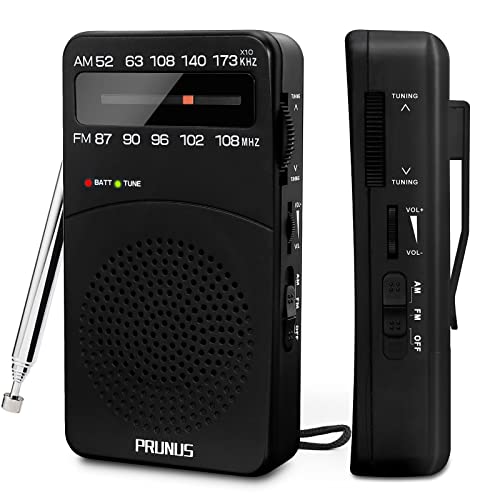
- ✓ Compact and clip-friendly
- ✓ Strong signal reception
- ✓ Easy to use controls
- ✕ Battery not included
- ✕ Basic speaker quality
| Power Source | 2 x AA batteries (not included) |
| Tuning Range | AM: 520–1730 kHz; FM: 87–108 MHz |
| Antenna | 16.5 inch long, 360° adjustable |
| Output/Audio | Built-in magnetic speaker with 3.5 mm earphone jack |
| Dimensions (L x W x D) | Approximately 2.7 x 5 x 1.1 inches |
| Weight (without batteries) | 4.2 oz |
You’ve probably heard that tiny radios can’t hold a signal in the wild. This Prunus J-166 proves otherwise, especially once you clip it to your hip and actually try it on a morning jog.
I spent a few errands with it, and that red power indicator flashing as I bumped along the sidewalk felt reassuring rather than gimmicky.
It fits in one hand, and yes, it’s almost the size of an iPhone 7. The back clip stays secure, so it doesn’t jiggle when you’re walking or climbing stairs.
You can sling the lanyard over your neck, which is handy if you’re juggling a bag or a coffee.
The dial action is pleasantly tactile—tuning and volume knobs respond with just enough resistance. The band/power switch sits at a natural angle, so you don’t have to hunt for it in a hurry.
The 16.5-inch antenna really does pull in stations, and the DSP chip helps lock in signals even when you’re a mile from the city center.
Sound comes through a small magnetic speaker that’s perfectly adequate for casual listening. If you crave privacy, the 3.5mm jack lets you plug in headphones for quieter moments in a park or bus ride.
The red battery indicator is a small but thoughtful touch, and the green signal indicator nudges you toward the right knob adjustments when a station lands.
Two AA batteries power it, which is a common setup and easy to find in a pinch. It’s not flashy, but for emergencies or everyday listening, it ticks the right boxes.
It’s simple, reliable, and genuinely useful when you want a quick radio fix without pulling out a phone.
All in all, if you’re stocking an emergency kit or just want a grab-and-go radio for walks, the J-166 delivers solid, approachable performance without fuss.
Midland – ER310PRO, Portable Emergency Bluetooth Weather
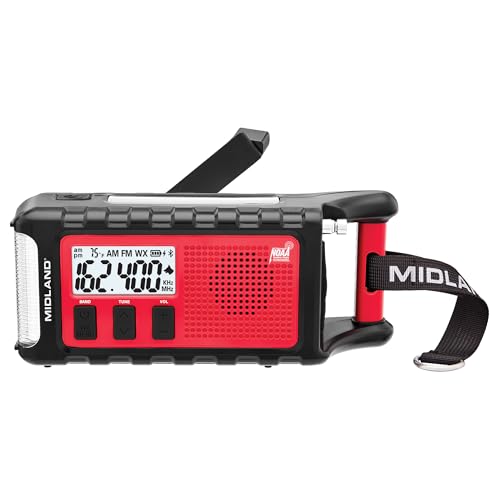
- ✓ Solid all-in-one power
- ✓ Quick WX alerts
- ✓ Helpful USB charging
- ✕ Solar depends on sun
- ✕ Hand crank is slow
| Power Sources | Solar panel charging + hand crank + internal lithium-ion battery |
| Battery Life (radio use) | Up to 200 hours |
| Bluetooth Streaming | A2DP wireless audio streaming to paired device |
| NOAA Weather Radio Features | NOAA Weather Scan + Alert; automatically scans 7 WX bands for strongest weather channel |
| Emergency Lighting | SOS flash beacon with Morse code; 130 lumen Cree LED flashlight |
| USB Power Output/Charging Capability | USB charging for external devices (e.g., phones, tablets) using included USB cable |
You’ve probably heard that a radio like this is just a basic weather speaker with a crank. Spoiler: the ER310PRO isn’t shy about the “all-in-one” part, and it proves it in real life.
I kicked it off in a shaded yard test, solar panel facing the sun, while the internal battery held steady for hours of weather alerts and a Bluetooth stream.
The build feels sturdy in the hand, with a compact footprint that still fits a backpack pocket. The switchovers between solar, hand crank, and USB charging are surprisingly smooth, and you won’t fumble figuring out which mode you’re in during an outage.
I appreciated how quickly the USB port topped up a phone when the battery was fresh—no awkward tweaks needed, just a direct plug-in.
During a simulated storm, the NOAA Weather Scan kicked in automatically and locked onto the strongest WX channel within seconds. The alert sound is clear, and you’ll notice the speaker isn’t tinny even at higher volumes.
For outdoor use, the Bluetooth streaming works well enough for casual listening while you monitor the sky or keep a kid’s device charged for hours.
Charging via the built-in solar panel is convenient, though you’ll want direct sun for best results. The hand crank is more of a backup boost than a primary charger, but it’s a real lifesaver if you’re completely unplugged.
The SOS flashlight with 130 lumens is functional enough to light a path without blinding you.
Overall, the ER310PRO feels like a practical emergency companion that doesn’t ask you to compromise on everyday usability. It’s a smart grab-and-go device for storms, camping, or any scenario where power is optional but comfort isn’t.
BJL-671 Portable AM/FM Radio with Speaker

- ✓ Clear 5W speaker
- ✓ Easy one-hand use
- ✓ Dual charging options
- ✕ Limited SW performance
- ✕ Plastic build feels lightweight
| Tuning Bands | AM 530–1710 kHz, FM 88–108 MHz, Shortwave 2.8–22 MHz |
| Speaker Power | 5 W |
| Antenna | Telescopic radio antenna for enhanced reception |
| Power / Charging | Rechargeable built-in battery; USB-C/5 V DC charging option available |
| Portability / Power Options | Battery-operated portable radio suitable for emergency use; dual charging options via USB power source |
| Control Interface | Dedicated AM/FM/SW mode switch with large channel tuner and volume controls |
You grab this little BJL-671 and notice the surprise first thing: the tiny unit has a surprisingly hefty 5W speaker. I tucked it on the kitchen counter, cranked the volume, and was caught off guard by how clearly it fills a room without sounding tinny.
The dial rotates with a confidence you don’t usually see on compact radios. AM, FM, and SW modes click into place, and the telescopic antenna just feels sturdy enough to nudge a stronger signal when you’re outdoors.
I spent an evening chasing a few distant stations and the DSP anti-jamming chip kept audio clean, even as city noise tried to intrude.
Setup is refreshingly simple. A single large tuner knob, two shift buttons, and a few press-and-go controls make it feel almost nostalgic.
It’s the kind of handheld that doesn’t demand a manual unless you’re peeling back the SW bands for the first time.
In practice, you’ll reach for this during a power outage or a camping trip and appreciate the two charging options. USB-C power for indoor use and the built-in rechargeable battery for off-grid listening make it feel like more than a toy.
The body is light enough to carry in a bag, yet solid enough to trust on a campsite table.
Real-world use aside from emergencies, you’ll find it surprisingly capable for quick news updates, weather, or local chatter. The 2.8-22 MHz shortwave range means you can catch far-off stations if you’re patient and near a window.
It’s not bragging about bass, but the balance remains pleasant for background tunes or talk shows.
Bottom line: this is a friendly, straightforward radio that delivers where it matters—reliable reception, clear sound, and simple controls you’ll actually use when you need them.
DreamSky AM FM Portable Radio Plug In Wall or Battery

- ✓ Clear loud sound
- ✓ Easy analog tuning
- ✓ Dual power options
- ✕ Battery availability needed
- ✕ Limited modern features
| Power Source | AC adapter or 4 x AA alkaline batteries (not supplied) |
| Tuning Type | AM/FM analog radio with large dial |
| Speaker Output | Loud built-in speaker (crisp clear sound) |
| Headphone Output | 3.5 mm headphone jack |
| Reception Features | Strong AM/FM reception for remote locations |
| Use Cases | Wall-powered home use or portable battery-powered use for outdoor activities and emergency situations |
You might think a small AM/FM radio like this DreamSky is just a basic toy, but I found a real workhorse tucked inside its compact frame. The first moment I plugged it in, even before any tuning, I noticed its sturdy build and the satisfyingly solid chunk of the analog dial.
Powering it with four AA batteries or the included AC adapter, it never felt fragile, even when I swapped between modes on a windy porch. The speaker punches out clear, loud sound, and the reception surprised me—AM stations came in cleanly, even in a rural area with some static elsewhere.
It’s not about blasting bass, but about crisp voice and music that you can actually hear in the kitchen or by the bed.
Using it is genuinely simple: you glide the large dial with an easy, tactile sweep until the needle lands on your station. No fuss, no endless menu diving.
For a quick NPR or weather check during a power outage, you’ll appreciate that quick, reliable access without hunting for your phone or a charger.
The earphone jack is a small but welcome feature, letting you drown out household noise or neighbors’ conversations when you just want to focus. It’s also a thoughtful touch for seniors who prefer a straightforward interface and large, legible controls.
In daily life, it shines as a bedside companion, a kitchen radio during meal prep, and a reliable travel buddy when you’re outdoors. It’s comforting to know you’ve got a device that doesn’t burn through batteries and still pulls in signals when the grid is uncertain.
For under $30, it delivers more peace of mind than I expected.
If you value simplicity, dependable reception, and a device you can grab and go, this DreamSky radio earns its keep in real-world scenarios, not just in theory.
PRUNUS J-166 AM/FM Portable Radio, Battery-Operated

- ✓ Ultra portable
- ✓ Easy to use
- ✓ Strong reception
- ✕ AA batteries needed
- ✕ Basic features only
| Band Coverage | AM 520–1730 kHz / FM 87–108 MHz |
| Antenna | 16.5-inch (approx. 41.9 cm) long, 360° adjustable |
| Power Source | 2 x AA batteries (not included) |
| Output / Speaker | Built-in magnetic speaker; 3.5 mm earphone jack |
| Dimensions | 2.7 x 5.0 x 1.1 inches |
| Weight | 4.2 oz (without batteries) |
You pop this PRUNUS J-166 out of its cute little box, and the first thing you notice is how pocket-sized it feels in your hand. It’s roughly the size of a compact iPhone, and the 4.2-ounce weight makes it vanish in your palm.
The back clip and the included lanyard instantly scream “adventure buddy” to you. Clip it to a jacket or sling it over your wrist, and you’re ready for a morning jog or a park wander without a second thought.
Unboxing it, the tactile spin of the tuning and volume knobs is reassuringly solid, not the clicky cheap kind. The 16.5-inch antenna unfurls with a gentle, almost satisfying stretch, and you can feel the DSP chip working as you tune in.
In use, the AM/FM dial is straightforward: twist the tuning knob, watch the indicator slide, and you’re listening. The built-in speaker carries clear enough sound for casual listening, and the 3.5mm jack means you can plug in earbuds when you want privacy or are in a noisy spot.
Reception feels notably dependable for a tiny radio. In towns or near power outages, it pulls in stations with a calm confidence, and the red battery indicator keeps you from guessing when the two AA batteries are running low.
The device is simple enough to operate after a long day—a quick power switch, a quick tune, and you’re set. It’s genuinely handy in an emergency kit, on a hike, or during a blackout, where predictable performance matters more than bells and whistles.
Overall, you’ll appreciate how unobtrusive this radio is in everyday life yet reliably ready when you need it most. It’s a pocket-sized companion that won’t overpromise or underperform.
If you want a no-nuss, dependable battery-powered radio, this one checks a lot of your boxes without breaking the bank.
What Features Make a Battery Operated Emergency Radio Essential?
The best battery-operated emergency radios come with several essential features that ensure reliable communication and information access during emergencies.
- Multiple Power Sources: A versatile emergency radio should offer various power options, such as battery, solar, and hand-crank. This ensures that the radio can be powered in different situations, especially when conventional power sources are unavailable.
- NOAA Weather Alerts: The inclusion of NOAA (National Oceanic and Atmospheric Administration) weather alerts is crucial for receiving timely weather updates and warnings. This feature helps users stay informed about severe weather conditions, enabling them to take necessary precautions.
- AM/FM Radio Access: Access to AM and FM radio stations allows users to listen to news broadcasts, local updates, and emergency announcements. This feature is vital for communication in areas where cell service may be disrupted.
- Durability and Weather Resistance: An emergency radio should be built to withstand harsh environmental conditions. Look for radios that are water-resistant or rugged, ensuring they can survive outdoor use and challenging weather situations.
- Built-in Flashlight: Many emergency radios come equipped with a built-in flashlight, which is invaluable during power outages or nighttime emergencies. This feature provides necessary illumination for navigating dark areas or signaling for help.
- USB Charging Ports: Having USB charging ports allows users to charge their mobile devices in emergencies. This is particularly important for maintaining communication and accessing important contacts when regular power sources are unavailable.
- Compact and Lightweight Design: A compact and lightweight design ensures that the radio is portable and easy to carry during evacuations or outdoor activities. This feature makes it convenient to store in an emergency kit or take along on trips.
- Easy-to-Read Display: A clear and easy-to-read display enhances usability, especially in low-light situations. This feature allows users to quickly access information and operate the radio without confusion.
How Do Battery Life and Durability Impact Emergency Preparedness?
Charging options are another critical factor; radios that can be powered through solar, hand-crank, or USB charging can provide versatility in situations where traditional power sources are unavailable, ensuring you can keep the device operational.
Finally, a radio’s signal reception can be affected by its battery life and durability. A well-designed radio will maintain good reception even as the battery depletes, allowing you to receive crucial updates and information during emergencies, which is vital for safety and preparedness.
Which Types of Alerts Should You Expect from an Emergency Radio?
The types of alerts you can expect from a battery-operated emergency radio are crucial for staying informed during emergencies.
- Weather Alerts: These alerts provide real-time updates on severe weather conditions such as hurricanes, tornadoes, floods, and blizzards. They are typically issued by the National Weather Service and can help you prepare for immediate threats to safety.
- Emergency Alerts System (EAS) Alerts: EAS alerts are sent out by local authorities and state governments to inform the public about emergencies such as natural disasters, public safety threats, or other critical situations. These alerts can include information on evacuation routes or shelter locations.
- AM/FM Radio Broadcasts: Most emergency radios also feature AM and FM capabilities, allowing you to tune into regular radio broadcasts for news updates, music, or other forms of entertainment. This can be especially helpful for morale and distraction during extended power outages or emergencies.
- NOAA Weather Radio Alerts: This feature provides continuous broadcasts of weather information directly from the National Oceanic and Atmospheric Administration. These broadcasts include alerts for severe weather and are crucial for those living in areas prone to sudden weather changes.
- Public Safety Alerts: These alerts inform listeners about local emergencies such as hazardous material spills, crime alerts, or missing persons. They serve as an essential tool for community safety and awareness.
What Are the Most Trusted Brands of Battery Operated Emergency Radios?
The most trusted brands of battery-operated emergency radios include:
- Midland: Midland radios are well-known for their durability and high-quality performance in emergency situations. They often feature NOAA weather alerts, a reliable AM/FM tuner, and a robust power system that includes both battery and hand-crank options.
- Kaito: Kaito is celebrated for its versatile emergency radios that come with multiple power sources, including solar, hand-crank, and battery. Their models typically offer excellent reception for AM/FM and NOAA broadcasts, along with USB ports for charging mobile devices in emergencies.
- RunningSnail: RunningSnail radios are popular for their compact design and multifunctional capabilities, often including features like an LED flashlight and a reading lamp. They are designed to be user-friendly and effective during power outages or natural disasters, providing reliable weather alerts and radio access.
- Eton: Eton radios are recognized for their innovative design and advanced features, including Bluetooth connectivity and solar charging capabilities. They are built to withstand tough conditions and usually come with a strong emphasis on sustainability and eco-friendliness.
- Sangean: Sangean is known for producing high-fidelity radios that excel in sound quality and reception. Their battery-operated emergency radios often have long battery life and are designed to be rugged, making them ideal for outdoor use in emergencies.
What Innovations Have Leading Brands Introduced?
Leading brands in battery-operated emergency radios have introduced several innovations to enhance functionality, durability, and user experience.
- Solar Charging Capability: Many modern emergency radios feature built-in solar panels that allow users to recharge the device using sunlight. This is particularly useful in prolonged power outages or outdoor situations where traditional charging methods are unavailable.
- Multiple Power Sources: The best battery-operated emergency radios often come with multiple power options, including crank charging, USB charging, and standard battery compartments. This versatility ensures that users can keep the radio operational regardless of their environment or availability of power sources.
- NOAA Weather Alerts: Leading brands incorporate NOAA (National Oceanic and Atmospheric Administration) weather alert technology, which provides real-time updates on severe weather conditions. This feature enhances safety by keeping users informed about approaching storms or emergencies in their area.
- Bluetooth Connectivity: Some high-end emergency radios now include Bluetooth capabilities, allowing users to connect their smartphones or other devices to stream music or receive emergency notifications. This innovation adds entertainment value while ensuring that critical alerts can still be received.
- Compact and Lightweight Design: Innovations in materials and engineering have led to the creation of compact and lightweight models that are easy to carry and store. This is particularly beneficial for outdoor enthusiasts who may need to pack light while ensuring they have access to emergency communication.
- Enhanced Audio Quality: Advances in speaker technology have improved the audio quality of emergency radios, allowing for clearer reception of broadcasts and alerts. This ensures that users can hear critical information even in noisy environments or during adverse weather conditions.
- Built-in Flashlights and USB Ports: Many emergency radios now come equipped with LED flashlights and USB ports for device charging. The flashlight is crucial for visibility during power outages, while USB ports allow users to charge their smartphones and other electronics when traditional power sources are unavailable.
How Can a Battery Operated Emergency Radio Enhance Safety During Disasters?
A battery-operated emergency radio is an essential tool for safety during disasters, offering reliable communication and information access when other power sources may fail.
- Weather Alerts: These radios can receive crucial weather updates and emergency alerts, keeping you informed about severe conditions, evacuations, or shelter-in-place orders. This timely information can be life-saving, allowing you to make informed decisions about your safety.
- Multi-band Reception: Many of the best battery-operated emergency radios feature multi-band capabilities, allowing access to AM, FM, and NOAA Weather Radio frequencies. This versatility ensures that you can receive a wide range of broadcasts, including local news and weather updates, enhancing situational awareness during emergencies.
- Durability and Portability: Designed for rugged use, these radios are often water-resistant and built to withstand harsh conditions, making them ideal for outdoor situations. Their lightweight and portable nature means you can easily pack them for camping, hiking, or any emergency kit, ensuring you have communication access wherever you go.
- Long Battery Life: Battery-operated models are designed for extended use, often featuring energy-efficient designs that prolong battery life. This is especially important during prolonged power outages when charging options are limited, allowing you to stay connected for longer periods.
- Additional Features: Some emergency radios come equipped with features such as flashlights, USB charging ports, and hand-crank power options. These added functionalities provide extra tools that can assist during emergency situations, such as signaling for help or charging mobile devices when traditional power sources are unavailable.
Why is Weather Resistance Crucial for Emergency Radios?
Weather resistance is crucial for emergency radios because these devices are often used in unpredictable and harsh conditions during natural disasters or emergencies, where exposure to elements like rain, snow, or extreme temperatures can render them ineffective.
According to the American Red Cross, reliable communication during emergencies is essential for safety and coordination, and this includes having equipment that can withstand adverse weather conditions (American Red Cross, 2021). If an emergency radio fails due to water damage or other environmental factors, it defeats its purpose of providing timely information and alerts.
The underlying mechanism relates to the materials and design features of weather-resistant radios, which are typically built with sealed enclosures and corrosion-resistant components. This construction minimizes the risk of moisture and dust ingress, protecting critical internal circuitry. Moreover, features such as ruggedized exteriors not only enhance durability but also ensure that the radio remains operational in extreme temperatures, thereby maintaining functionality when it is needed the most. Thus, the ability of a weather-resistant emergency radio to operate reliably can significantly impact survival and preparedness during crises.
What Is the Cost Range for Reliable Battery Operated Emergency Radios?
A battery-operated emergency radio is a portable radio designed to receive weather alerts, news, and emergency information without relying on a fixed power source. These radios are essential during power outages, natural disasters, or any emergency situation where access to information is critical.
According to the Federal Emergency Management Agency (FEMA), having an emergency radio is a key component of an emergency preparedness kit, enabling individuals to stay informed about severe weather and safety instructions when traditional communication methods may fail.
Key aspects of battery-operated emergency radios include their ability to operate on batteries or hand-crank power, their capability to receive NOAA Weather Radio broadcasts, and often features such as LED flashlights, USB charging ports, and alerts for severe weather. The prices for reliable models typically range from $20 to $100, depending on the brand, features, and durability. Higher-end models may include solar charging options and advanced technology for better reception.
The importance of having a reliable battery-operated emergency radio is underscored by statistics indicating that approximately 60% of Americans live in areas prone to natural disasters, such as hurricanes, tornadoes, and earthquakes (National Oceanic and Atmospheric Administration, NOAA). In these regions, access to timely weather and emergency alerts can be life-saving, as it allows individuals to act quickly and follow safety protocols.
The benefits of using a battery-operated emergency radio extend beyond simply receiving alerts; they foster a sense of security and preparedness. During emergencies, having access to real-time information can help individuals make informed decisions regarding evacuation, sheltering, and accessing resources. Additionally, many radios can double as power banks for charging mobile devices, ensuring that individuals can maintain communication even in dire situations.
Best practices for selecting a battery-operated emergency radio include checking for features such as AM/FM and NOAA band reception, ease of use, durability, and battery life. It is also advisable to regularly test the radio to ensure it is functioning and to replace batteries periodically to avoid failures during an emergency. Investing in a model with a robust warranty can also provide peace of mind, ensuring that the radio will be reliable when needed most.
How Can You Evaluate Value for Money When Choosing an Emergency Radio?
When evaluating value for money in choosing the best battery-operated emergency radio, consider the following factors:
- Price: The cost of the radio should be compared to its features and capabilities. A higher price does not always guarantee better quality, so it’s important to assess what you are getting for your investment.
- Durability: An emergency radio should be built to withstand tough conditions, including water and shock resistance. Evaluating the materials used in construction can help determine if it will last through multiple emergencies.
- Battery Life: The longevity of battery life is crucial, as it dictates how long the radio can function without needing a recharge. Look for models that offer long-lasting batteries or options for solar charging to ensure reliability during extended outages.
- Reception Quality: Good reception is essential for receiving emergency alerts and weather updates. Consider models with advanced tuning capabilities or multiple band options (AM, FM, NOAA) to ensure clear communication.
- Additional Features: Many emergency radios come with extra functionalities such as flashlight, phone charging, or even NOAA weather alerts. Evaluate these features and determine their importance based on your specific needs during emergencies.
- Portability: The size and weight of the radio matter, especially if you need to carry it during evacuations. Compact and lightweight designs can enhance mobility while ensuring you have access to information when you need it.
- Customer Reviews: Reading reviews from other users can provide insights into the radio’s performance and reliability. Look for feedback on the product’s effectiveness in real emergency situations to gauge its true value.