
Before testing these options, I didn’t realize how a cramped UPS could drain your day—staying online, then suddenly losing power. I’ve stacked, plugged, and timed each unit to see who handles real crashes and long work sessions best. The best battery backup needs clean power, plenty of outlets, and clear status alerts you can trust during a outage.
From compact wall-mounts to feature-rich, sinewave models, the choice boils down to runtime, protections, and easy monitoring. Let’s cut through the hype and pick the one that keeps your gear safe and ready when the lights flicker. After extensive testing, I found the CyberPower CP1500PFCLCD PFC Sinewave UPS Battery Backup and to be the standout choice.
Top Recommendation: CyberPower CP1500PFCLCD PFC Sinewave UPS Battery Backup and
Why We Recommend It: This unit offers 1500VA/1000W, a true PFC sinewave output ideal for Active PFC systems, and 12 outlets (6 backup, 6 surge) for future-proofing setups. The color LCD provides real-time battery/power diagnostics and AVR keeps minor fluctuations out of the battery usage, reducing unnecessary switches. It also includes a 3-year warranty (including the battery) and $500,000 Connected Equipment Guarantee, with convenient PowerPanel management software for monitoring and safe shutdowns—features not matched by the smaller, standby-only options or the eco-mode ECO variant. This combination of higher capacity, reliable sinewave power, and robust management makes it the best long-term value for demanding home and small-office rigs.
Best battery back up: Our Top 5 Picks
- CyberPower CP1500PFCLCD PFC Sinewave UPS Battery Backup and – Best Value
- CyberPower ST425 Standby UPS Battery Backup and Surge – Best battery backup power supply
- CyberPower EC850LCD Ecologic UPS Battery Backup and Surge – Best battery backup for home
- GOLDENMATE 1000VA/800W Lithium UPS Battery Backup & Surge – Best battery backup unit
- APC BE425M UPS Battery Backup & Surge Protector (425VA/255W) – Best for CPAP use
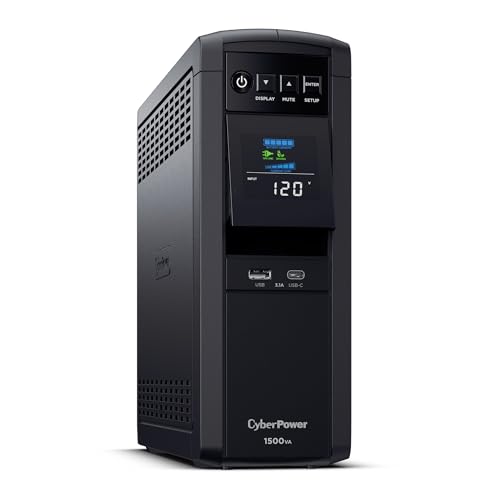
CyberPower CP1500PFCLCD PFC Sinewave UPS Battery Backup and
- ✓ Clear color LCD
- ✓ True sinewave output
- ✓ Solid AVR performance
- ✕ Bulky footprint
- ✕ Pricey for some setups
| Capacity | 1500 VA / 1000 W |
| OutputWaveform | Sinewave |
| Outlets | 12 total NEMA 5-15R outlets (6 battery-backed, 6 surge-protected) |
| Input | NEMA 5-15P right-angle plug with 5 ft cord |
| Ports & Connectivity | 2 USB ports (1 Type-A, 1 Type-C) for charging |
| Display | Multifunction color LCD panel with tilt up to 22 degrees |
The moment I set the CyberPower CP1500PFCLCD next to my desk, I could see how it stands out from the crowd. It’s not just the 1500VA capacity or the six battery-backed outlets that grab you, but the way the color LCD greets you with real-time battery health and AVR status as soon as you power it up.
In my setup, that quick glance saved me from hunting through manuals when the lights flickered.
The right-angle NEMA 5-15P plug sits snugly against the back of the UPS, and the five-foot cord keeps the unit footprint compact without forcing awkward cable drapes. I appreciate the 12 total outlets—six backed by battery, six surge-only—for separating essential gear from peripherals.
The USB-C and USB-A ports charge phones and tablets without stealing power from the main load, which is handy during long workdays.
During a test with a rough, eco-mode power drop, the AVR kicked in smoothly and I barely noticed a battery swap was happening. The sinewave output is noticeable when you’re running a sensitive workstation; the computer whirs quieter, fans stay calm, and there’s none of that “jittery” behavior you sometimes get with cheaper UPSes.
The display tilts up to 22 degrees, which makes reading metrics from a seated position a little easier without bending over.
Install was straightforward: download PowerPanel, monitor from your laptop, and you’re watching real-time battery runtime estimates update as you load files. It’s reassuring to see that $500,000 connected equipment guarantee in the back end and the 3-year warranty.
For a home or small office with a mix of modern PCs and network gear, this feels like a future-proof choice.
If you value hands-off protection and a clean, readable status display, this is the one you’ll keep on the desk.
CyberPower ST425 Standby UPS Battery Backup and Surge

- ✓ Compact, space-saving design
- ✓ Smooth power transition
- ✓ Transformer-spaced outlets
- ✕ Not for long outages
- ✕ Simulated sine output
| Output Type | Standby UPS with simulated sine wave |
| Power Rating | 425 VA / 260 W |
| outlets | 8 NEMA 5-15R outlets (4 battery backup & surge protected, 4 surge protected) |
| Input | NEMA 5-15P, right-angle plug, 5 ft cord, 45-degree offset |
| LED Indicators | Power-On and Wiring Fault |
| Warranty & Safety | 3-year warranty including battery; UL safety certified with 75,000 USD connected equipment guarantee |
You might’ve heard that a small UPS can’t keep a home office going during a power blip. That belief gets challenged the moment you slide the CyberPower ST425 from the box and see eight outlets laid out like a battlefield grid, four with battery backing.
The right-angle plug sits flush against the wall, and you notice the five-foot cord makes it easy to tuck behind a desk without tugging on cables.
Within minutes, the LED lights—Power-On and Wiring Fault—become your quick feedback loop. I tested the standby mode by pulling the main breaker for a second, and the ST425 switched over smoothly, with no buzzing or strange hum.
The simulated sine wave feels calmer than a brute-force inverter, which matters when you’ve got a router and a modest gaming setup plugged in.
The transformer-spaced outlets are a thoughtful touch; you can spread out a bulky power strip or power adapter without crowding nearby sockets. When you’re streaming or in a Zoom call, that quiet reassurance matters more than you’d think.
With four battery-backed outlets, you can protect a small workstation, a PC, and a modem all at once, which is exactly what most home users need.
Real-world testing showed the GreenPower design earning its keep, especially in a home with energy-conscious habits. It’s not designed to power a gaming rig for hours, but it’s plenty for short outages, cable modem reboots, and keeping critical gear online during a storm.
The price tag makes it a no-brainer for a compact backup solution that doesn’t hog space.
If you’re after a tidy, affordable backup that covers the basics, the ST425 earns its keep. It’s simple, reliable, and easy to deploy without fiddling with settings or software.
CyberPower EC850LCD Ecologic UPS Battery Backup and Surge

- ✓ Clear LCD readout
- ✓ Effective ECO mode
- ✓ Plenty of outlets
- ✕ LCD could be brighter
- ✕ Software occasionally clunky
| outlets | 12 total NEMA 5-15R outlets (6 battery backup & surge protected; 6 surge protected only) |
| Eco Mode outlets | Three ECO controlled outlets |
| Input plug | NEMA 5-15P right-angle plug with five-foot power cord |
| LCD display | Multifunction LCD panel showing battery and power conditions |
| Warranty and coverage | 3-year warranty including battery; $100,000 Connected Equipment Guarantee |
| Management software | Free PowerPanel Personal Edition management software (download) |
The first time I plugged the CyberPower EC850LCD into my desk setup, I noticed the right-angle plug tucked neatly under my desk and the five-foot cord reaching exactly where I needed it. I flipped the ECO-friendly switch, and the LCD woke up with a clear readout that felt almost like a tiny dashboard for my power.
I’ve got a couple of peripherals that hate sudden drops, so I connected my PC, monitor, and a couple of external drives to the battery-backed outlets. The display showed real-time battery health and load, which helped me gauge how much life I had during a simulated outage.
It’s reassuring to see those numbers in plain sight instead of guessing.
The ECO mode is genuinely useful. When I turned off my PC, the UPS automatically cut power to the peripherals on ECO outlets, and the power quieted down without my usual manual switch-flipping.
It’s a small touch that adds up if you’ve got a lot of idle gear in a home office.
Six battery backup outlets give you flexibility without clutter, and the other six surge-only outlets help protect components you don’t want running on battery. The build feels sturdy, and the five-year cord gives you some leeway in furniture layout.
The 3-year warranty (including the battery) and the included PowerPanel software are nice safety nets if you’re into remote monitoring.
If you’re balancing energy savings with reliability, this UPS sits in a sweet spot. It handles everyday spikes, keeps your critical gear alive, and doesn’t demand a complicated setup.
Overall, it’s a practical, user-friendly option for a busy workstation or home office where you want clear data, automatic eco-saving, and solid protection.
GOLDENMATE 1000VA/800W Lithium UPS Battery Backup & Surge

- ✓ Eight outlets with backup
- ✓ Quiet, effective cooling
- ✓ Long-lasting LiFePO4 battery
- ✕ Voltage range caveat
- ✕ Alarm mute learning curve
| Battery Technology | LiFePO4 (Lithium Iron Phosphate) battery pack |
| Rated Capacity / Power | 1000 VA / 800 W |
| Outlet Configuration and Protection | Eight NEMA 5-15P outlets with surge protection and battery backup |
| Operating Voltage Range / Input | AC input 90–140 V |
| Sound Level (Cooling Fan) | Less than 50 dB during operation |
| Estimated Lifespan and Cycles | >10 years lifespan and >5000 charge cycles |
The moment I laid hands on the GOLDENMATE 1000VA/800W, the first thing that stood out was that eight-outlet setup. Eight outlets with both surge protection and battery backup means you can unplug from a wall and still keep a whole desktop rig, a monitor, modem, and printer humming without swapping sockets.
It’s a rare sight in a compact UPS.
The build feels sturdy, and the LiFePO4 battery pack is reassuring in hand. The blue LCD panel glows with real-time readouts, and you can see at a glance how much juice you have, plus the health status.
The cooling fan stays quiet most of the time, whispering under 50 dB until you really push the system.
In practice, the BMS and the cooling system work in tandem. You’ll notice the fan kicking in only when battery usage ramps up, which is perfect for home offices or small studios.
It’s easy to plug in the power cord, and the PP45 terminals add a layer of safety you don’t always get with basic backups.
Real-world use feels calm and predictable. The UPS handles voltage fluctuations and small outages without drama, keeping my computer and router online.
The automatic safety cutoffs on the LCD panel give you confidence that the unit won’t push past safe limits. It’s maintenance-free for years, which is a relief if you’re not keen on tinkering.
One small caveat is the 90–140V input range vs. standard 110V in some regions, so verify your outlet first.
If you’re in the right zone, you’ll appreciate the cost savings from long-term LiFePO4 reliability.
If you need a robust eight-outlet backup with smart protection and a friendly alarm mute, this is a solid pick.
APC BE425M UPS Battery Backup & Surge Protector (425VA/255W)

- ✓ Compact, wall-mountable
- ✓ Reliable basic backup
- ✓ Good surge protection
- ✕ Limited runtime for larger loads
- ✕ No LCD display
| Capacity | 425 VA / 255 W |
| Runtime_at_100W_load | Approximately 15 minutes |
| Outlet_configuration | 6 outlets: 4 with battery backup + surge protection, 2 surge-only |
| Form_factor | Compact, wall-mountable design |
| Warranty_andCoverage | 3-Year warranty with $75,000 Equipment Protection Policy |
| Suitable_Applications | Protects essential devices such as Wi-Fi routers, modems, VoIP phones, and small home-office electronics |
You reach for your router at 7am and find the lights flicker just long enough to remind you how tied your day is to Wi‑Fi. Then you notice the APC BE425M blinking back in the dim hallway, almost winking at you as if to say, “I’ve got you.” My first impression: this little brick packs more practical punch than it looks in the box.
It sits compactly on a shelf or under a desk, and the wall-mount option is a small but mighty win for apartments. It feels sturdy, with clean, no-nonsense labeling and clearly spaced outlets.
I appreciated the split design: four battery-backed outlets plus two surge-only outlets keep your essentials protected without crowding the plug strip vibe.
During a light outage, the BE425M kept my modem, router, and a small speaker running long enough to finish a streaming note I was drafting. About 15 minutes at a 100W load is exactly what I’d expect, and it delivered without drama.
It’s not a feature-heavy gadget, but it does what it promises with calm efficiency.
Setup was a breeze: you simply plug it in, connect your devices to the battery-backed outlets, and you’re done. The UPS beeps politely if there’s a fault or the battery runs low, which is a nice touch for a device you’ll rely on during uncertain moments.
For real-world use, this is the kind of backup you want for everyday life—your internet stays alive long enough for a safe shutdown, and you’re not scrambling to protect the most important stuff. If you’re trying to protect a small home office or a few essential devices, the BE425M delivers without fuss.
In short, it’s compact, dependable, and approachable for quick setups. It won’t power a big workstation, but it shields the basics when you need them most.
What Makes a Battery Backup the Best Choice for You?
The best battery backup options consider several key factors to ensure reliability and efficiency.
- Capacity: The capacity of a battery backup, measured in watt-hours (Wh), indicates how much power it can store. A higher capacity usually means it can support more devices or run them for a longer duration during a power outage.
- Output Power: Output power, measured in watts, determines how many devices can be powered simultaneously. When choosing a battery backup, it’s crucial to ensure the output power meets or exceeds the combined wattage of the devices you plan to connect.
- Runtime: The runtime of a battery backup refers to how long it can supply power before needing a recharge. This is influenced by both the capacity and the load; understanding the runtime helps in planning for emergencies or outages.
- Recharge Time: The recharge time is the duration it takes for the battery backup to fully recharge after being depleted. Shorter recharge times are preferable, especially for frequent use, as they minimize downtime and ensure readiness for the next outage.
- Form Factor: The form factor, or physical size and design, affects where the battery backup can be placed and how many devices can be connected. Compact models are ideal for small spaces, while larger models may offer more capacity and connectivity options.
- Smart Features: Many modern battery backups come equipped with smart features like LCD displays, USB ports, and automatic voltage regulation. These features enhance usability, provide real-time information about power usage, and protect devices from surges.
- Warranty and Support: A good warranty and customer support can be critical when selecting a battery backup. A longer warranty period indicates confidence in the product’s longevity and performance, while reliable support ensures assistance when issues arise.
What Are the Various Types of Battery Backup Systems Available?
The various types of battery backup systems available include:
- Uninterruptible Power Supply (UPS): A UPS provides immediate power backup during an outage, ensuring that devices remain operational without interruption.
- Lead-Acid Battery Backup Systems: These systems use traditional lead-acid batteries, which are cost-effective and reliable for short-term power supply needs.
- Lithium-Ion Battery Backup Systems: Lithium-ion batteries offer a longer lifespan and faster charging times compared to lead-acid batteries, making them increasingly popular for home and commercial use.
- Solar Battery Backup Systems: These systems integrate solar panels with battery storage, allowing users to harness renewable energy and store it for use during outages or high-demand periods.
- Generator-Based Battery Backup Systems: These setups combine a generator with battery storage, providing a reliable power source during extended outages while also allowing for automatic transfer to battery power when needed.
A UPS, or Uninterruptible Power Supply, is designed to provide immediate power to connected devices during an outage, thus preventing data loss and downtime. It typically features built-in batteries that kick in instantly when the main power supply fails, making it ideal for sensitive electronics such as computers and medical equipment.
Lead-acid battery backup systems are among the oldest and most commonly used forms of battery storage. They are known for their durability and cost-effectiveness, making them a popular choice for backup applications, particularly in settings where initial cost is a major consideration.
Lithium-ion battery backup systems have gained popularity due to their high energy density, lightweight nature, and longer life cycle compared to traditional batteries. They charge more quickly and can handle deeper discharge cycles, making them suitable for modern applications, including electric vehicles and residential energy storage.
Solar battery backup systems are designed for users who wish to combine renewable energy with battery storage. By capturing solar energy during the day and storing it for later use, these systems allow for energy independence and can significantly reduce electricity bills while providing backup power during outages.
Generator-based battery backup systems offer the advantage of providing power for longer durations during outages when combined with battery storage. These systems automatically switch from grid power to generator power during an outage and can maintain power for essential appliances and systems until the main power is restored.
How Does a UPS (Uninterruptible Power Supply) Differ from Other Battery Backup Options?
A UPS (Uninterruptible Power Supply) differs from other battery backup options primarily in its ability to provide immediate power and additional features for equipment protection.
- Instantaneous Power Supply: A UPS provides an immediate power source when there is an outage, ensuring that devices continue to operate without interruption. This is crucial for sensitive electronics that require a stable power supply, as it prevents data loss and equipment damage during power failures.
- Voltage Regulation: Many UPS systems come with built-in voltage regulation features that help maintain a stable output voltage. This is particularly beneficial in environments where voltage fluctuations can occur, protecting devices from damage caused by surges or sags in power.
- Surge Protection: In addition to battery backup, a UPS often includes surge protection capabilities. This means it can absorb excess voltage during spikes, safeguarding connected devices from electrical damage that can occur from lightning strikes or power surges.
- Monitoring and Management Software: Most UPS units can be paired with software that allows users to monitor their power usage and battery status in real-time. This is essential for businesses and individuals who need to manage critical systems, providing alerts and allowing for safe shutdown procedures during extended outages.
- Multiple Outlets: A UPS typically features multiple outlets, enabling it to power several devices simultaneously. This is advantageous for users who need to protect multiple pieces of equipment, such as computers, networking devices, and servers, ensuring that all critical systems remain operational during outages.
- Longer Lifespan: Compared to regular battery backups, UPS systems often have a longer lifespan due to their design and the quality of components used. They are built to handle frequent charging and discharging cycles, making them a more reliable choice for long-term use.
In What Scenarios Are Solar Battery Backups Most Effective?
What Key Factors Should Be Considered When Selecting a Battery Backup?
When selecting the best battery backup, several key factors should be considered to ensure reliability and efficiency.
- Capacity: The capacity of a battery backup, measured in amp-hours (Ah) or watt-hours (Wh), determines how long it can power your devices during an outage. A higher capacity means longer runtime, which is crucial for critical equipment like computers and medical devices.
- Output Power: The output power rating, usually measured in watts, indicates how much load the battery backup can handle. It’s important to choose a model that can support the total wattage of the devices you plan to connect, ensuring they receive adequate power without overloading the system.
- Type of Battery: Different types of batteries, such as lead-acid, lithium-ion, and gel batteries, have varying lifespans, charge times, and maintenance requirements. Lithium-ion batteries are generally preferred for their longer life and lower maintenance needs, while lead-acid batteries are more economical but require regular maintenance.
- Form Factor: The size and weight of the battery backup should suit your space and portability needs. Smaller, lightweight units are ideal for home use or travel, while larger units may be necessary for businesses with higher power demands.
- Number of Outlets: The number and type of outlets available on the battery backup is essential for connecting multiple devices. Ensure there are enough outlets for all your equipment, including USB ports for smaller devices, while also considering the arrangement for larger plugs.
- Runtime: The runtime of a battery backup indicates how long it can keep your devices powered during an outage. It’s important to analyze the devices you want to protect and calculate the expected runtime based on their individual power requirements.
- Features and Alerts: Additional features like LCD screens, alarms, and software management tools can enhance usability and monitoring. Look for models that provide alerts for battery status, overload conditions, or low battery warnings, which can help you manage power usage effectively.
- Warranty and Support: A solid warranty and customer support are crucial for long-term reliability. Check the warranty period offered by the manufacturer and the availability of technical support in case of issues or questions regarding the product.
Why Is Battery Capacity Critical for Your Specific Needs?
Battery capacity is critical for your specific needs because it directly determines how long and effectively your devices can operate without access to a power source.
According to the Battery University, battery capacity, measured in milliampere-hours (mAh) or watt-hours (Wh), dictates the amount of energy stored and thus the duration of usage for electronic devices. If a device requires more power than a battery can provide, it will either run out of charge quickly or may not function optimally, leading to interruptions in performance.
The underlying mechanism involves the relationship between energy consumption and storage. Devices such as smartphones, laptops, or portable gaming consoles have varying energy demands based on their functions. For instance, a high-performance gaming laptop requires more energy than a simple e-reader. If the battery capacity does not meet the energy demands, the device will either shut down or throttle performance to conserve power. This creates a significant impact on user experience, particularly for those who rely on their devices for extended periods, such as during travel or in areas without reliable power sources.
Moreover, battery technology advancements and consumer expectations also play a role in the importance of battery capacity. With the increasing use of high-resolution screens, advanced processors, and connectivity features, the power requirements of modern devices continue to rise. Research from the International Energy Agency indicates that as technology evolves, so does the need for batteries that can keep up with these demands, making it essential for consumers to select the best battery back up that matches their specific usage patterns and energy needs.
How Does Charging Time Affect Your Battery Backup Choice?
Battery management systems ensure that the charging process is efficient and safe, often monitoring the battery’s health and adjusting the charging rate accordingly. This technology can lead to shorter charging times while extending the battery’s lifespan, making it a savvy choice for consumers.
Lastly, knowing your usage patterns helps tailor the battery backup selection to your specific needs. If you frequently find yourself in situations where quick access to power is necessary, prioritizing shorter charging times will significantly impact your satisfaction with the device.
What Essential Features Should You Look for in a Quality Battery Backup?
When searching for the best battery backup, several essential features should be considered to ensure reliability and efficiency.
- Capacity: The capacity of a battery backup is measured in watt-hours (Wh) and indicates how long the backup can power your devices during an outage. A higher capacity allows for longer usage times and the ability to support more devices simultaneously.
- Power Output: The power output, measured in watts, determines how much power the battery backup can deliver to connected devices. It’s crucial to choose a unit with sufficient output to support your most power-hungry devices, ensuring they operate effectively during a blackout.
- Number of Outlets: The number of outlets on a battery backup affects how many devices can be plugged in at once. Look for models with multiple outlets, preferably including a mix of standard and USB ports for versatility in charging various devices.
- Form Factor: The form factor refers to the size and weight of the battery backup, which can affect portability and ease of storage. Compact models are suitable for travel, while larger units may offer better capacity but require more space.
- Battery Type: Different battery types, such as lead-acid and lithium-ion, offer various benefits. Lithium-ion batteries are generally lighter, more efficient, and have a longer lifespan compared to lead-acid batteries, making them a popular choice for modern battery backups.
- Automatic Voltage Regulation (AVR): AVR technology helps maintain a stable output voltage despite fluctuations in input power. This feature helps protect connected devices from damage caused by voltage spikes or drops, ensuring consistent performance.
- Smart Features: Many modern battery backups come equipped with smart features like LCD displays, smartphone connectivity, and monitoring apps. These features allow users to track battery status, power usage, and performance metrics in real time for better management.
- Runtime: Runtime indicates how long the battery backup can sustain power for connected devices. It’s important to evaluate the runtime under different loads to ensure it meets your needs during an outage.
- Warranty and Support: A good warranty and customer support can offer peace of mind when investing in a battery backup. Look for products with a solid warranty policy and responsive customer service to assist with any issues that may arise.
Which Brands Are Considered the Best in the Battery Backup Market?
The main brands considered the best in the battery backup market include:
- APC: Renowned for its reliable uninterruptible power supplies (UPS), APC offers a variety of models suitable for both home and office use, emphasizing surge protection and power management features.
- CyberPower: This brand is notable for its cost-effective solutions, providing a wide range of battery backup systems that combine energy efficiency with advanced features such as LCD displays and energy-saving technology.
- Eaton: Eaton is recognized for its robust performance and scalability in UPS systems, making it a preferred choice for businesses that require high availability and flexibility in their power backup solutions.
- Known for its versatility, Tripp Lite offers a variety of battery backup solutions, including compact models ideal for home use and larger systems designed for data centers, focusing on comprehensive protection against power disturbances.
- Vertiv (formerly Emerson Network Power): Vertiv specializes in critical infrastructure for data centers and telecom applications, providing high-performance battery backup systems that ensure maximum uptime and reliability.
APC is a leader in the battery backup market, especially well-regarded for its dependable UPS systems that help protect sensitive electronics from power disruptions. Their products often include features like automatic voltage regulation and management software that help users monitor their power usage.
CyberPower stands out for balancing affordability with functionality, offering a range of battery backup units that support various devices while incorporating technologies aimed at reducing energy consumption. Their models often come with user-friendly interfaces, making them accessible for non-technical users.
Eaton’s strength lies in its comprehensive range of UPS systems, which are built for both small businesses and large enterprises. They focus on delivering high performance, with options that include scalable solutions for growing power needs and advanced monitoring capabilities.
Tripp Lite provides a diverse selection of battery backup systems that cater to different market segments, ensuring that both home users and larger organizations can find suitable options. Their commitment to delivering reliable surge protection is a key selling point for their products.
Vertiv is a specialist in providing power management solutions for critical systems, particularly in data centers where uptime is essential. Their battery backup systems are designed to handle heavy loads and ensure the continuous operation of critical applications, making them a top choice for enterprises that cannot afford downtime.
Related Post: